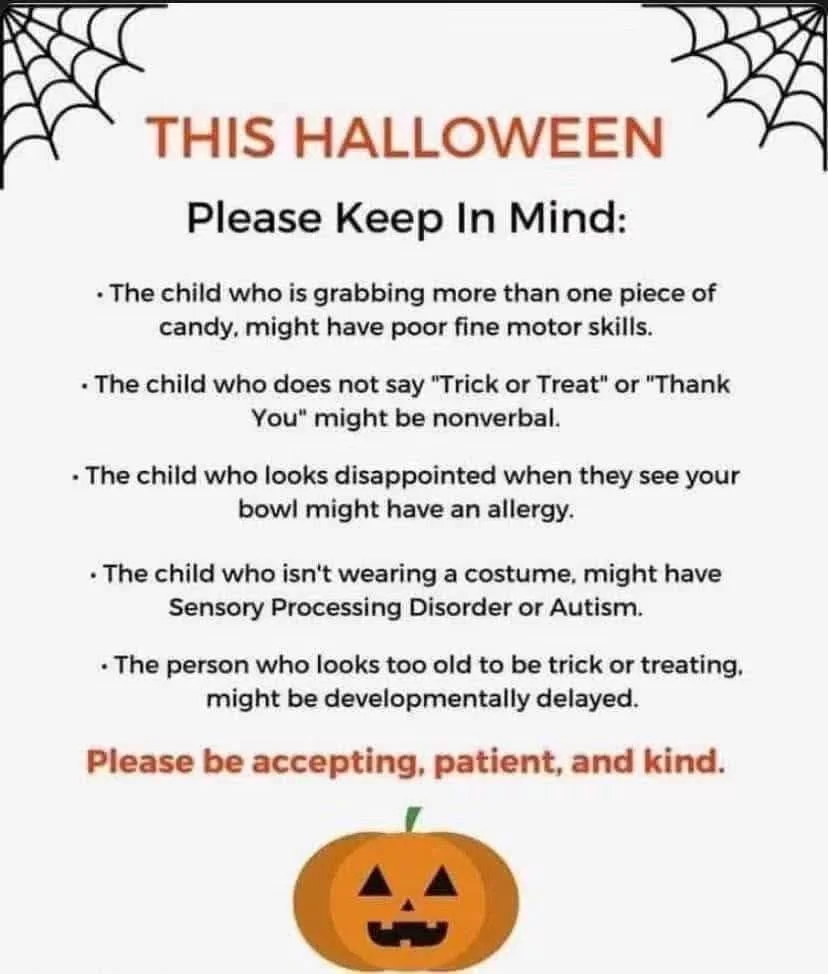
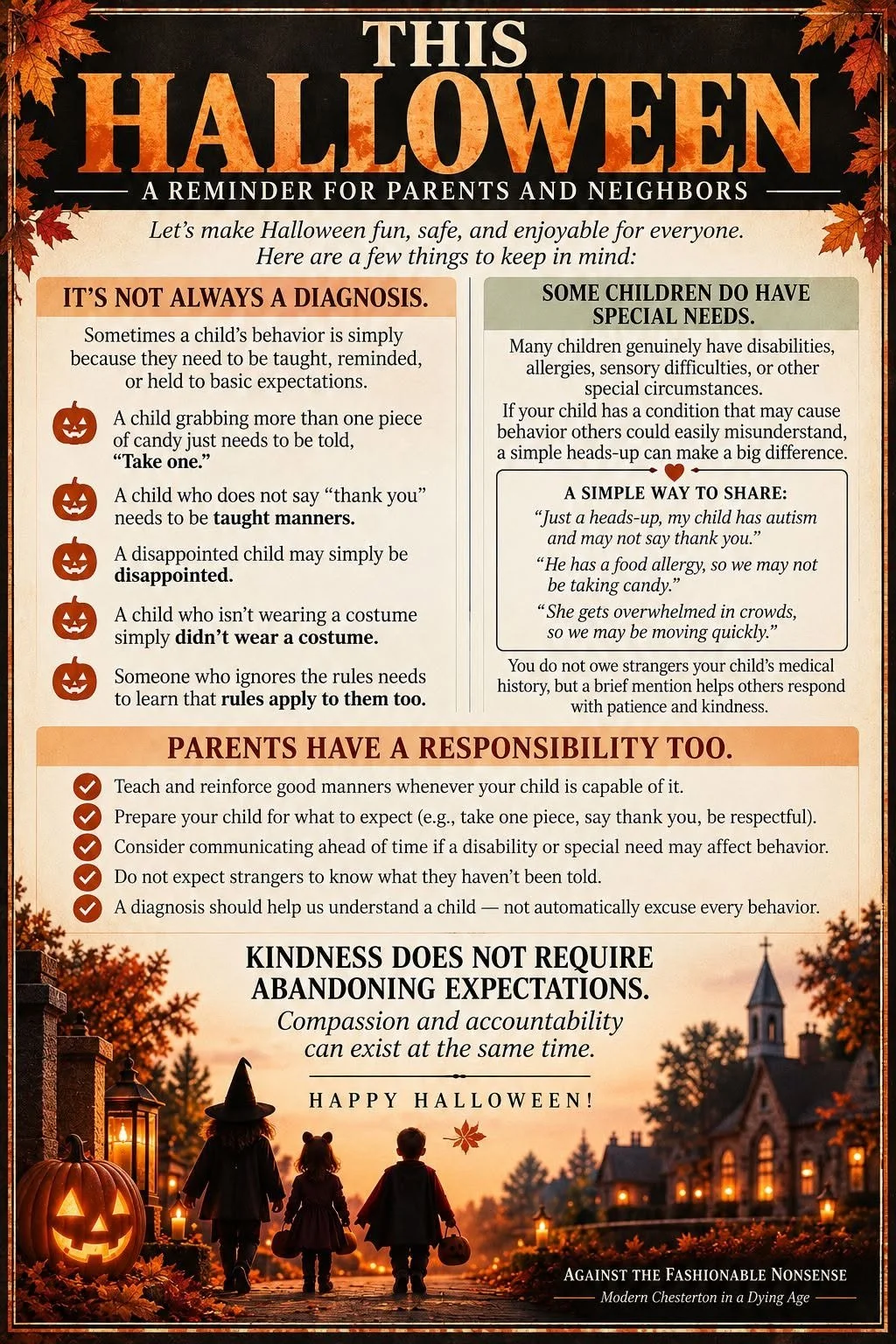
Every October, a familiar graphic makes the rounds on social media.
The child who grabs several pieces of candy may have poor fine-motor skills. The child who doesn't say “thank you” may be nonverbal. The child without a costume may have sensory difficulties. The teenager who appears too old for trick-or-treating may have a developmental disability.
The conclusion is admirable:
Be accepting. Be patient. Be kind.
Absolutely.
There are children with autism, developmental disabilities, allergies, sensory difficulties, and other challenges invisible to the stranger answering the door. We should make room for them.
But there is another possibility we seem increasingly hesitant to mention:
Sometimes a child who takes three pieces of candy simply needs to be told to take one.
Not Everything Is a Diagnosis
A child doesn't say thank you. Perhaps he is nonverbal.
Or perhaps he needs to be reminded to say thank you.
A child grabs a handful of candy. Perhaps she struggles with fine-motor control.
Or perhaps she's eight years old, there is an enormous bowl of Reese's Cups in front of her, and eight-year-olds occasionally require supervision around chocolate.
A disappointed child may have an allergy.
Or he may simply have wanted a Snickers.
Children are, after all, children.
This isn't about dismissing genuine disabilities. In fact, constantly attributing ordinary childhood behavior to possible diagnoses can trivialize the very real challenges faced by children who actually have them.
Children also need something more than understanding.
They need formation.
Compassion Doesn't Mean Abandoning Expectations
Knowing why a child struggles should help us determine how to help him. It doesn't necessarily mean we stop expecting anything from him.
A diagnosis may change how we teach a child. It may require patience, repetition, accommodation, or entirely different expectations.
But genuine compassion asks:
“What is this particular child capable of, and how can I help him get there?”
That is especially important because manners aren't meaningless rules.
“Please” recognizes that I am asking something from another person.
“Thank you” recognizes that I've received something I wasn't owed.
Waiting my turn recognizes that other people matter.
Taking one piece when someone says “Take one” recognizes that generosity isn't permission to take everything.
These are tiny lessons.
But civilization is largely constructed from tiny lessons.
And Parents Have a Responsibility
The neighbor answering the door with a plastic pumpkin full of Kit Kats cannot possibly know every child's circumstances.
If something might easily be misunderstood, a simple explanation can work wonders:
“My son is autistic and may not say thank you.”
“She has a food allergy, so we're being careful tonight.”
“He gets overwhelmed in crowds, so we're moving quickly.”
No apology. No medical history. Just ordinary communication between human beings.
Parents can also prepare children beforehand: take one unless you're offered more; say thank you if you're able; don't push; don't complain about the candy; respect other people's property.
That's part of what makes Halloween work.
Neighbors are generous to children. Children learn how to receive generosity. Parents help them do it.
Assume Neither the Worst Nor the Diagnosis
We don't have to choose between rigidly enforcing every rule and abandoning expectations altogether.
There is a third possibility.
It's called prudence.
Accommodate genuine disabilities. Teach children what they're capable of learning. Correct ordinary misbehavior. Give people the benefit of the doubt when you don't know their circumstances.
In other words:
Assume neither the worst nor the diagnosis.
Be patient when patience is needed. Correct when correction is needed. Explain when explanation would help. And give people a little grace when you don't know the whole story.
And if an eight-year-old Batman accidentally takes two Reese's Cups?
Civilization will probably survive.
Happy Halloween.